Published on: June 11, 2026
For decades, concrete repair has followed a familiar process. Crews use chipping hammers to remove deteriorated material and then move on to the reconstruction phase. The process works, but it comes with tradeoffs. Vibration moves through the structure, and noise limits when and where work can happen.
Hydrodemolition changes what is possible on a repair project. It increases production and minimizes disruptions by allowing work to continue in environments where traditional methods fall short. In this spotlight, we wanted to offer an inside look at how Charter leveraged an innovative hydrodemolition approach to execute a recent repair project in a high-stakes environment.
The Challenge: The Limitations of Traditional Demolition
Vanderbilt University Medical Center has partnered with Charter on several projects, and they reached out for work needed on their East Garage. It presented a classic structural restoration problem: water intrusion had led to deteriorated concrete that required removal and repair. However, the logistical constraints were immense.
Traditional percussive demolition methods—the standard jackhammers and chipping guns—transfer vibrations through embedded reinforcement and structural steel. When you are performing structural repairs directly beneath active operating rooms and labor and delivery wards, the stakes change.
At VUMC, using a traditional demo approach would require frequent work stoppages. Crews could only work for short intervals before hospital operations required a total pause.
Our team realized that to protect the hospital’s mission while meeting the project’s deadline, we had to stop fighting the limitations of the hammer and find a completely different way to keep the project moving forward.
The Solution: Hydrodemolition and Selective Removal
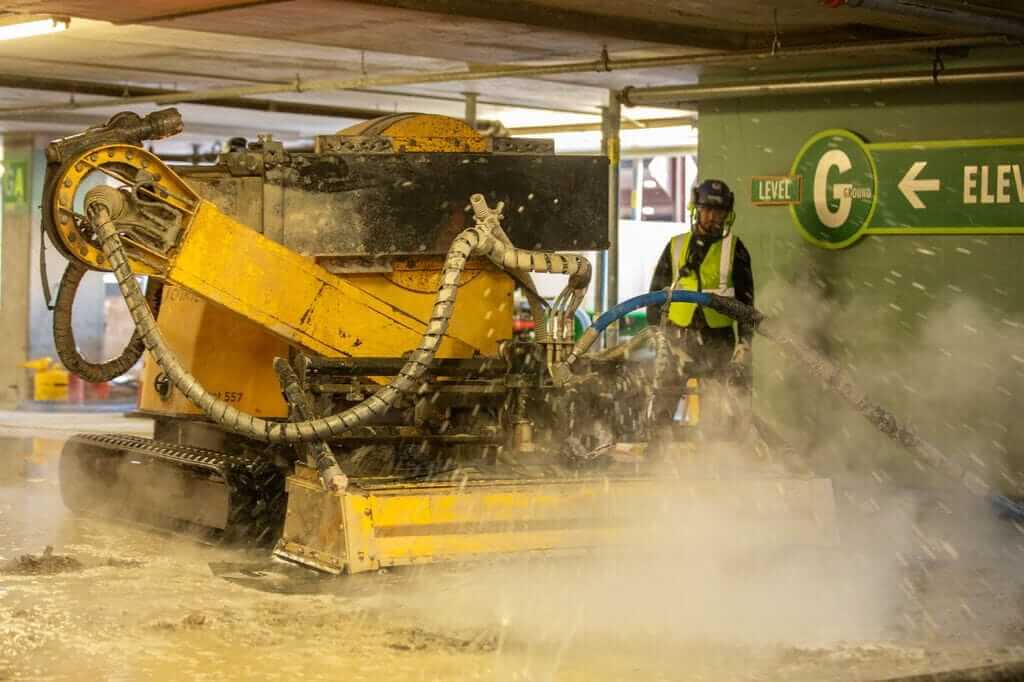
Hydrodemolition is a coordinated system made up of several interconnected components working at the same time. At the center is a robotic demolition unit that uses ultra-high-pressure water to remove deteriorated concrete without the percussive force of traditional methods. This unit uses water delivered at pressures approaching 20,000 PSI and flow rates of roughly 40 gallons per minute to remove concrete. Operators can control the system remotely, maintaining a safe distance while adjusting parameters in real time.
Instead of transferring vibration through reinforcing steel and structural elements, the system breaks down unsound concrete while leaving the surrounding structure largely unaffected. The level of control is what sets the system apart. Our team could fine-tune pressure, travel speed, and nozzle positioning to achieve consistent removal depths. With millions of potential parameter combinations, the system adapts to varying concrete conditions, reinforcement congestion, and structural requirements.
Supporting that robotic unit is a full water management system. A high-capacity vacuum collects water and debris as the demolition occurs. That material moves into a filtration and purification setup, where suspended solids are removed before the water is recirculated back into the system.
The result is a closed-loop operation that maintains control of both the demolition process and the surrounding environment.
An Inside Look at the Process
Here’s an inside look at how our team implemented the hydrodemolition process on VUMC’s East Garage:
Planning Before Execution
Charter spent over a year planning the operation before mobilization. The team worked closely with equipment manufacturers to develop a system tailored to the project’s constraints. They evaluated logistics, crew structure, water supply, and containment strategies. Every step of the process was mapped out before the first day of operation.
Leadership made a deliberate investment in training and preparation. Field crews learned how to operate and maintain the system safely. Inspection protocols were established to verify pressure lines, connections, and equipment performance before each shift.
This level of planning set the foundation for success. When the system arrived on site, the team was ready to run it.
Experienced Leadership in the Field
Running a hydrodemolition operation is complex. Multiple systems operate at the same time, all water must stay contained, and production must remain consistent. Field leadership made that possible by establishing clear roles and communication across the crew. Each team member understood their responsibility within the system, from operating the robotic unit to managing vacuum recovery and filtration.
Assistant Repair Manager Andres Mora and Project Foreman Torran Downs played a key role in this effort. They took ownership of the system, worked through the learning curve, and kept operations moving at a high level. The structure of the operation allowed the team to make real-time adjustments as conditions changed. That flexibility proved critical when working in a live environment with no margin for error.
Managing Water and the Jobsite Environment
One of the most technical challenges was water management. Hydrodemolition requires a steady supply of water at high volume and pressure. At the same time, environmental regulations prevent uncontrolled discharge.
Charter addressed this with a closed-loop system. Mobile containment berms captured water at the source while a high-capacity vacuum system removed slurry from the work area. Filtration units separated solids, allowing water to be reused.
The system recirculated the majority of the water used during operation, with only minor loss from evaporation and absorption. This approach reduced demand on the jobsite water supply and ensured compliance with environmental requirements.
The Impact: What This Means for Clients and Partners
Innovation is only valuable if it delivers results. At East Garage, the metrics speak for themselves:
- Eliminating Noise Complaints. In nearly two months of operation at VUMC, we did not receive a single noise complaint.
- Faster Demo Timelines. While we are still collecting long-term performance data, early data suggest that our hydrodemolition unit can accomplish in a single day what would traditionally require a manual demolition crew up to a full week to complete.
- Greater Precision. The robotic unit allows operators to fine-tune multiple parameters that directly influence removal depth. With over two million potential parameter combinations, we can precisely control concrete removal even when working in areas with varying concrete densities or reinforcement congestion.
- Safer Working Environments. Hydrodemolition eliminates the prolonged physical strain associated with operating heavy chipping hammers and reduces crew exposure to repetitive impact forces. At the same time, Charter invested in manufacturer training and implemented rigorous daily inspection protocols prior to operation.
Charter Construction: Innovative Solution-Seekers
At Charter Construction, we’ve built a reputation for taking on the toughest jobs. When standard methods create limitations, our team looks for better solutions. That might mean new equipment, new processes, or a completely different way of thinking about the work.
Clients trust Charter with difficult projects because of our mindset. Hydrodemolition is one example of our approach in action.