Published on: May 15, 2026
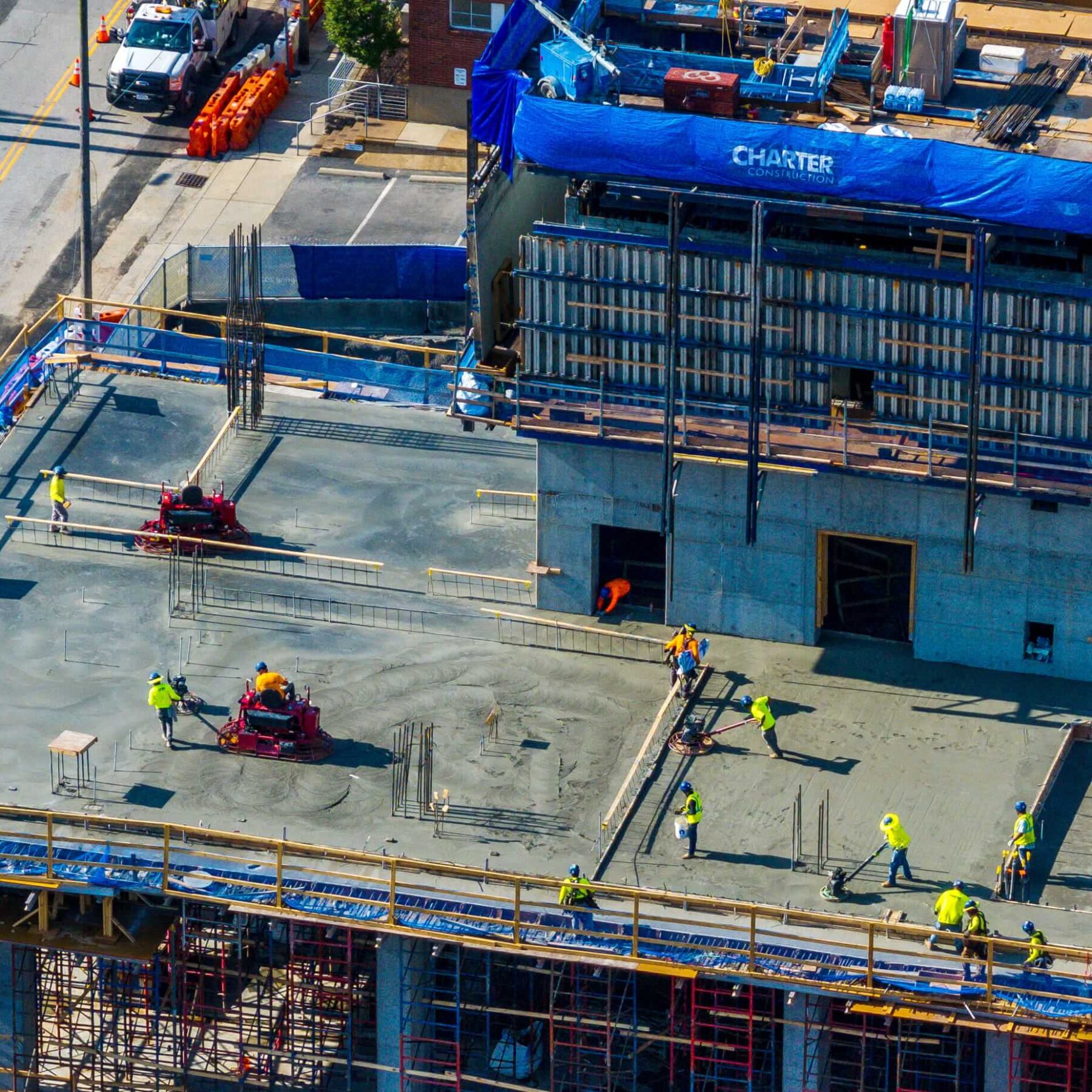
Complex projects often reveal their biggest challenges below grade, especially with Nashville’s volatile and unpredictable topography. That proved true at The Ray, a 32-story, 575,000 SF high-rise located in Nashville’s Pie Town neighborhood. As the structural concrete contractor, Charter Construction took on a full-scope package that includes rock anchors, foundations, slab-on-grade, elevated slabs, vertical elements, post-tension systems, and shoring/reshoring for the entire structure. Working alongside Layton Construction, the team began work in December 2024.
Early in the project, unforeseen subsurface conditions created immediate pressure on the schedule. Instead of slowing down, Charter’s team leaned into the challenge. Leadership and field crews worked side by side with the GC to resequence activities, adjust manpower, and implement advanced formwork systems to recover lost time. That early collaboration set the tone for how the project would move forward.
Solving Below-Grade Challenges with Smarter Coordination
Unpredictable subsurface conditions, particularly around rock anchor installation, forced the team to rethink how work progressed below grade. Rather than allowing delays in one area to stall the entire project, Charter implemented a creative sequencing strategy that prioritized the below-grade structure directly beneath the tower. This allowed critical path work to continue moving forward while a secondary crew focused on surrounding areas that were not immediately tied to vertical progress.
“Instead of reacting to problems in real time, our team anticipated them,” shared Jonathan Rizkallah, Senior Project Manager. “That approach reduced rework, improved efficiency, and kept crews productive during a phase where delays are common.”
To support this approach, Charter also deployed a handset formwork system that reduced reliance on the crane. The result was a more flexible operation that maximized productivity and helped recover time during one of the most constrained phases of the project.
Pushing Through Rock Anchor Complexity
Rock anchor installation became one of the most demanding aspects of the project. Subsurface variability and groundwater infiltration slowed footing progress and required constant coordination with the geotechnical engineer, design team, and client.
Charter’s field crews took a hands-on, solution-focused approach. They tested alternate drilling locations, adjusted layouts in real time, and implemented methods to manage water infiltration.
“While one crew worked through anchor challenges, others accelerated follow-up activities like rebar placement and formwork to keep overall progress moving,” Jonathan shared. “That flexibility made the difference. The team did not wait for perfect conditions. They adapted, stayed productive, and maintained forward momentum during one of the toughest phases of the job.”
A Team Effort That Drives Results
From leadership to the field, this project has been defined by innovation and communication. Project leadership empowered crews to make real-time decisions while staying closely involved to remove roadblocks.
The field team’s performance continued to drive the project forward. Their ability to maintain quality, safety, and productivity despite early challenges has positioned the job for a strong transition into vertical construction.
Notably, the team topped out four weeks ahead of the expedited schedule — a significant achievement for both Charter and Layton given the pace and complexity of this high-rise.
The Ray stands as a clear example of how Charter approaches complex work. When conditions get tough, our team does not back off. They plan, adapt, and keep building.