Published on: January 27, 2026
When Turner Construction Company tapped Charter Construction to perform the structural concrete scope for Tennessee Oncology’s new flagship cancer center, the stakes were high. As the general contractor, Turner Construction led the project with clear expectations and consistent communication, creating a foundation for strong collaboration across all trades.
From day one, the Charter team worked hand-in-hand with Turner to align on goals and deliver a complex below-grade structure that met the owner’s high expectations. Led by Senior Project Manager Jonathan Rizkallah and Superintendent Ethan Bruce, the Charter team embraced the pace and pressure, leveraging close coordination between field crews and office staff to keep work flowing and deadlines intact.
Over the course of nine months, Charter placed more than 15,500 cubic yards of concrete and installed nearly 1,670 tons of rebar, overcoming a host of on-site complexities with skill, speed, and innovation.
Tackling Complexity Below Grade
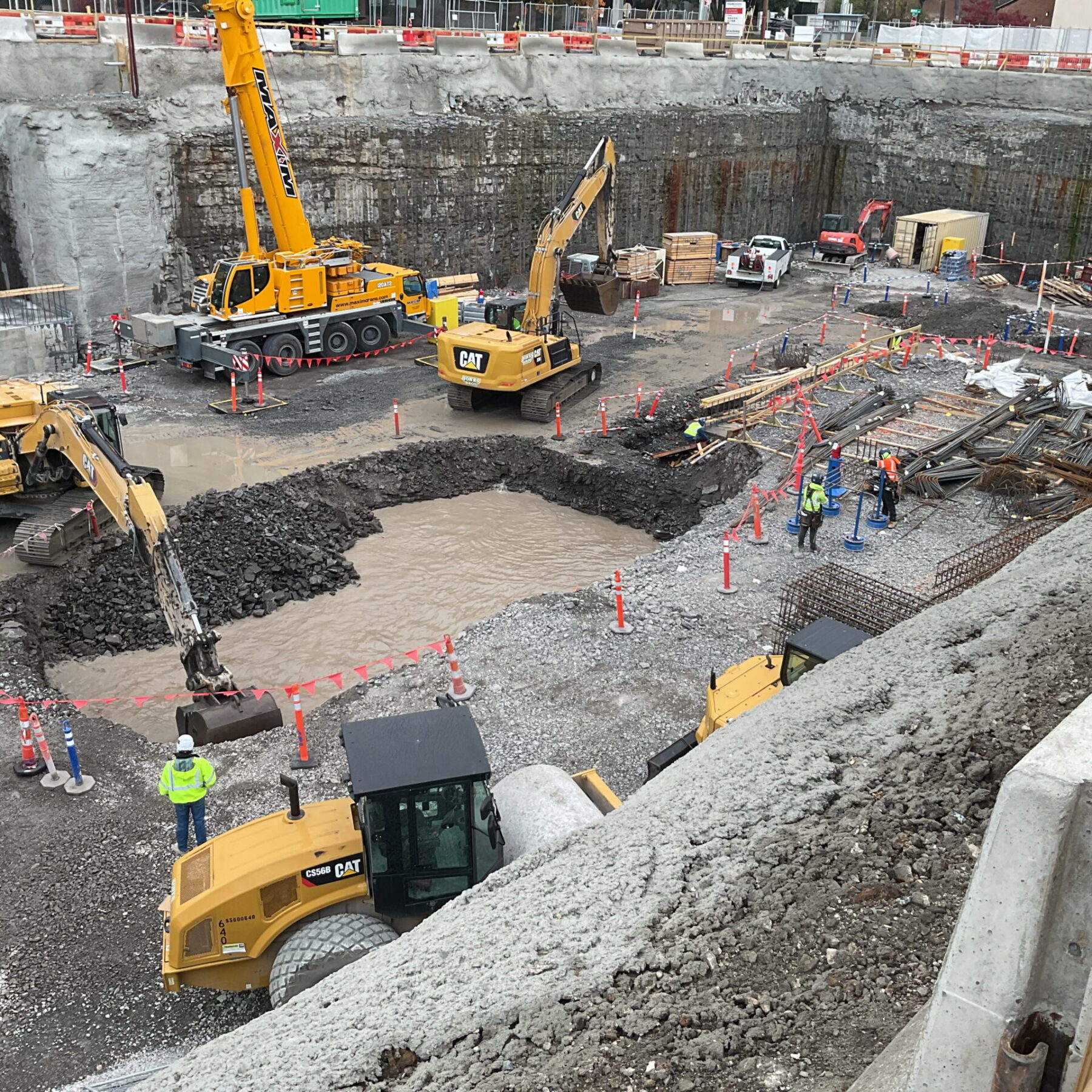
One of the most significant challenges was the below-grade nature of the structure, which introduced a range of coordination and sequencing issues from the start. Excessive groundwater during excavation disrupted early progress, but Turner and Charter worked to quickly secure a large-capacity pump and implement overnight dewatering.
Superintendent Ethan Bruce played a critical role in steering the field team through these challenges. His proactive coordination of pour planning and embed layout helped avoid costly delays, and his ability to forecast quantities with near pinpoint accuracy ensured the team remained on schedule.
“The key to staying on track was constant adaptation,” said Jonathan Rizkallah. “Ethan and the crew stayed laser-focused on every pour. Their real-time adjustments were instrumental to our success.”
Innovation Through Modeling and Material Tracking
To manage the project’s complexity, Charter implemented several innovative tools and techniques that helped streamline execution and reduce waste. Laser scanning of the mass excavation during preconstruction helped the team better model site conditions, advise on required design modifications, and forecast costs.
Another key efficiency came through Assistant Project Manager Spencer Burge’s work on concrete mix tracking. After unanticipated puddle mix volumes threatened to push the project over budget, Spencer stepped in to coordinate more detailed tracking of mix quantities and labor hours.
“Spencer’s diligence helped us get a better handle on cost impacts mid-project,” Jonathan said. “He also played a big role in managing vendors and keeping our schedule aligned.”
The team also utilized pour quantity summary sheets that allowed real-time comparisons between projected and actual volumes, giving the field team tighter control over execution and cost tracking.
Resequencing for a Faster Finish
Throughout the build, Charter’s leadership team maintained a close cadence with Turner Construction to keep things moving. Turner’s willingness to adapt baseline schedules and provide consistent updates every few weeks helped keep momentum high and expectations clear. Their openness to field-driven feedback created space for Charter’s team to stay proactive and adjust quickly, especially around key sequencing milestones and layout needs.
Midway through the project, our team identified an opportunity to resequence the work in a way that would open up additional opportunities for crew members and accelerate progress. But it required a full-court press to revise shop drawings, realign coordination efforts, and communicate the new strategy across all impacted trades.
Thanks to close collaboration with Turner Construction and decisive execution in the field, the transition went smoothly. Not only was Charter able to bring in more manpower, but the team also exceeded their original pacing, ultimately delivering the project six weeks ahead of schedule.
“We saw an opportunity to move faster while also giving more crew members a chance to get on the job,” Jonathan said. “It was intense, but the way the team adapted and executed was one of the most impressive parts of the project.”
Meanwhile, daily verbal check-ins between field crews and the GC allowed the team to stay ahead of potential issues before they became formal delays. According to Jonathan, this commitment to real-time collaboration was a hallmark of the project.
“Our field team deserves a ton of credit,” he said. “They were constantly adjusting sequencing and manpower based on real-time needs. That kind of awareness and responsiveness is what makes these projects successful.”
Corey Moore, who led the rebar team in the field, was particularly instrumental in navigating those adjustments. His leadership ensured smooth rebar sequencing and quick resolution of detailing issues as they came up on site.
A Team Win with Long-Term Impact
The TN Oncology project reflects not only Charter’s technical capabilities and teamwork but also the power of partnership. We’re especially grateful for Turner Construction’s leadership and collaboration throughout the build. Working alongside a GC who shares our commitment to quality and communication made all the difference on a complex, fast-paced structure like this one.
From pour planning and material coordination to field adaptability and scheduling agility, every member of the team contributed to a successful outcome. For Charter, this project marks another key addition to its growing portfolio of healthcare infrastructure work in the Nashville region.
“The most rewarding part was watching the field and leadership teams come together,” Jonathan said. “This project showed what we’re capable of when we trust each other, communicate openly, and stay focused on delivering for the client.”